The Way to Doubtful Sound, Stop by Stop: Lake, Pass and Fiord
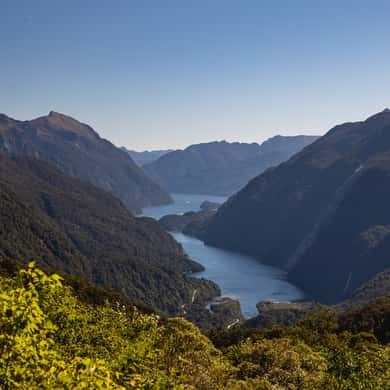
The short answer. Every trip to the fiord runs the same way: the jetty at Manapouri, about an hour across Lake Manapouri, a coach over the pass, then the boat at the head of the fiord. The run takes about 1.5 to 2 hours each way before you reach the cruise, and every stage is worth watching. Pick a Doubtful Sound boat tour by where you start, not by the route, which never changes.
The route at a glance
| Stage | How you travel | Time | Look for |
|---|---|---|---|
| The jetty in Manapouri | On foot | Check in 20 minutes early | Coffee and lunch to take |
| Lake Manapouri | Boat | About 45 minutes to 1 hour | Wooded islands, mist on the water |
| The far end of the lake | On foot | A short change | The power station's information centre |
| The pass | Coach | About 45 minutes to 1 hour | Rainforest, and the first view of the fiord |
| The head of the fiord | On foot | A short change | The boats waiting at the wharf |
| The fiord and its arms | Cruise boat | About 2 to 3 hours | Waterfalls, seals, dolphins |
Pearl Harbour, Manapouri
Your day starts at Pearl Harbour, on Waiau Street in Manapouri, where RealNZ runs the check-in. Be there 20 minutes before your start. If you are on a coach from Te Anau or Queenstown, the coach brings you to the same jetty. A reviewer notes a coffee shop at the jetty and another in town, handy for picking up lunch before you board.
Lake Manapouri
The first boat crosses the lake for about 45 minutes to an hour. The lake is scattered with wooded islands, and the ranges close in as you head west. DOC warns that the lake can turn rough and choppy quickly, particularly in the afternoons, so the morning crossing is often the calmer one. One reviewer on an early start watched the sun rise over mist on the lake.
West Arm and the power station
The boat docks at West Arm, the far end of the lake. This is the site of the Manapouri Power Station, whose machine hall sits 200 m below the lake. There are no tours of the station, but you may have time at the information centre. The plan to raise the lake for the station led to the Save Manapouri campaign, whose 1970 petition drew 264,907 signatures. The lake was not raised, and you are crossing the one they saved. The whole story is on the Doubtful Sound history page.
Wilmot Pass
A coach meets you at West Arm and climbs Wilmot Pass, 671 m, through dense rainforest. The gravel road was built from 1963 to 1965 to carry loads of up to 97 tonnes from ships at the fiord to the station. It connects to no other road in New Zealand, which is why the coaches live at the lake end and the boats bring you to them. Drivers stop in the forest and at a lookout where you get your first view of the fiord far below.
Deep Cove
The road ends at Deep Cove, at the head of the fiord. There is no settlement here, only an outdoor education centre and a small fleet of fishing boats that work for cod and crayfish. The station's tailrace, a tunnel about 10 km long, releases its water here after the drop from the lake. You step from the coach onto the cruise boat at the wharf. How you reach this point by your own vehicle, and why few people do, is set out in getting to Doubtful Sound.
The fiord and its three arms
From Deep Cove the boat heads out along the fiord, 40 km from its head to the Tasman Sea and 421 m deep. It branches into three arms, and boats often turn into one of them for the quiet stop. The walls rise straight from the water, covered in forest where they are not bare rock. After rain they run with waterfalls; on a dry day you get reflections instead.
Watch the water, too. Bottlenose dolphins live in the fiord, kekeno haul out on the rocks, and tawaki nest along the shore. None of them is promised on any day, and the boats keep their distance by rule. What they can see and when is on Doubtful Sound wildlife.
The way back
You return the same way: the boat to Deep Cove, the coach back over the pass, and the lake boat to Pearl Harbour. It is the same road, but the light has moved, so the views are not the same. Expect the second half to feel quicker, because you know the stages.
The boats can differ, though. Karin, who went from Te Anau, found the boat home smaller and less comfortable than the one out, and Madeleine, on the Manapouri day, found it loud. If you are sensitive to engine noise, sit outside on the lake leg home. And if the fiord is the part you care about most, remember that the stages cannot be skipped: the only ways to shorten the journey are to start at the jetty or to fly.
What most people miss
- The colour of the water. Rain lays a layer of fresh water on the sea, stained by the forest the colour of weak tea.
- The quiet. When the engines stop, you hear waterfalls and birdsong. Early Māori named the fiord Patea, the place of silence.
- The information centre. The stop at West Arm is short, but it explains the station you are standing on.
- The rainforest stop. The coach pauses in the forest on the pass. Step off and listen before the lookout.
Photographs, stage by stage
Morning light is best on the lake and at the lookout on the pass. On the fiord, the best frames come when the boat stops in an arm and the water is still. On the overnight cruise you also get the fiord at dusk and dawn, the two times a day boat never sees it. Rain is not a reason to leave the camera away; the waterfalls only come with it. For the season that suits the pictures you want, see the best time to visit Doubtful Sound.
If you would rather see the whole thing from above in an hour, read boat or helicopter before you book.
Ways to make the whole journey
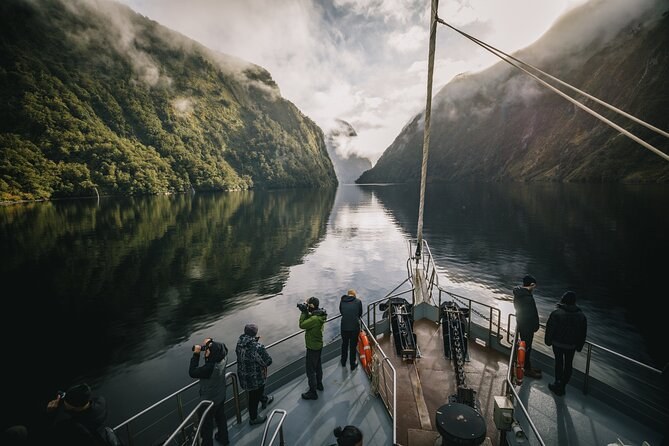
Doubtful Sound Wilderness Cruise from Te Anau
Nine hours from 85 Lakefront Drive in Te Anau: the coach to Manapouri, the lake crossing, the pass and a cruise of about 2 hours 45 minutes.
From $221 per person
Check Availability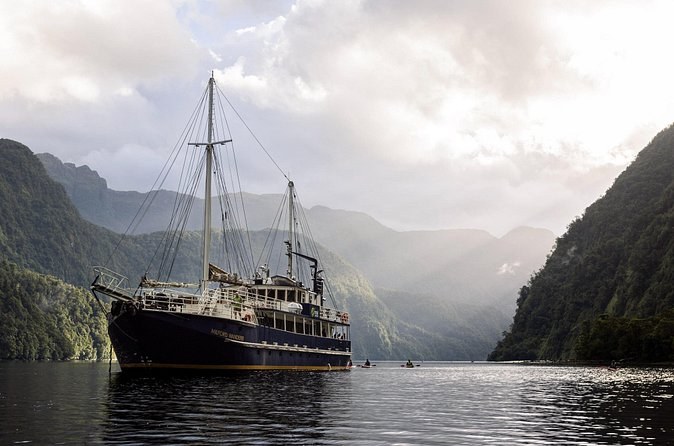
Doubtful Sound Overnight Cruise
About 20 hours on the fiord: an afternoon cruise, a three-course dinner, a cabin at anchor and breakfast on the water. Booked in twos, and non-refundable.
From $462 per person, bookings of two
Check Availability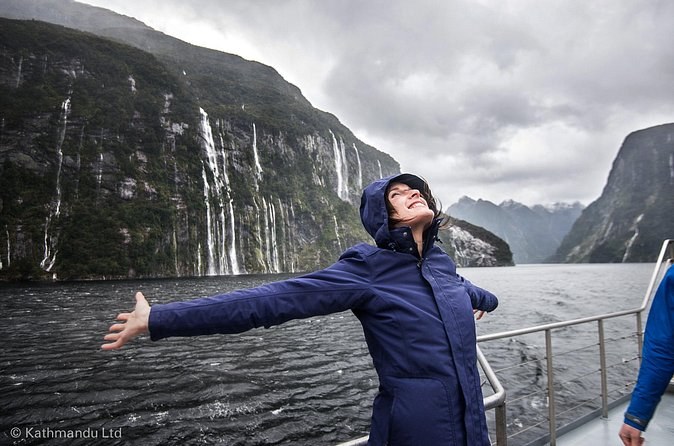
Doubtful Sound Wilderness Cruise from Queenstown
Twelve hours from 88 Beach Street in Queenstown by coach, lake boat and the pass, with a cruise of about 2 hours 45 minutes on the fiord.
From $277 per person
Check AvailabilityNext: Choose the start that saves you the most road, then book your seat. Every fare sits side by side on Doubtful Sound Tours.